My homelab, run like production. An OptiPlex holds every byte of state, a
Raspberry Pi watches it, and a dual-GPU Threadripper runs a 35B model on local
hardware. Nothing is open to the internet, and every decision is written down,
including the ones that turned out wrong.
3
nodes, each trusted with one kind of work
0
ports open to the internet
35B
parameter model on local GPUs
1s
camera clip to plain-English sentence
health checkcamera clipAI description
Architecture
sentinel — Pi
forge — OptiPlex
synapse — Threadripper
Hardware
Raspberry Pi, microSD
i7-7700T (35W), 16GB, NVMe
9960X, 2× RTX 5070 Ti 16GB, 32GB
Job
Alerting, front door
All state, metrics
Inference, agent
Failure mode
SD card death
OOM, disk fill
GPUs on another job
Trusted with
Saying something is wrong
Anything that must survive a reboot
Work that can be skipped
Why the work is split this way
forge holds anything that must survive a reboot. Databases, the queue
broker, bookkeeping, metrics history and the camera archive. It is the box with
the real availability guarantee and fast local storage, so it is the only node
trusted with state.
sentinel exists to watch the others. ~5W, separate power, separate storage,
separate failure modes — so when forge falls over, the thing that says so is not
part of the outage (ADR-0001). The service dashboard lives here too: a front door
that dies with the box it points at is not useful.
synapse does the GPU work, and nothing critical waits on it. It serves the
agent's model and enriches other pipelines, but it is treated as optional: it gets
torn down for benchmarking, and its GPUs get lent to other projects. Every
consumer is built so that synapse being down costs a feature, never an alert.
What is running
Containerized, each node with its own Portainer, every service addressed by Tailscale name:
Node
Role
Component
sentinel
Uptime monitoring and alerting
Uptime Kuma
sentinel
Service dashboard (sees all nodes)
Homepage
forge
Metrics and dashboards
Prometheus, Grafana, node-exporter, cAdvisor
forge
Relational database, queue broker
PostgreSQL with pgAdmin, Redis
forge
Double-entry bookkeeping
Manager.io
forge
Camera ingest, archive, alerts
blink-watch + detector (custom)
forge
Boot-time self-repair
docker-port-healer (systemd)
synapse
Local inference
vLLM — Qwen3.6-35B-A3B, NVFP4, 2-GPU
synapse
AI agent (Discord)
Hermes Agent
synapse
Agent egress allowlist, search
Squid, SearXNG
forge, synapse
Read-only Docker API for the dashboard
docker-socket-proxy
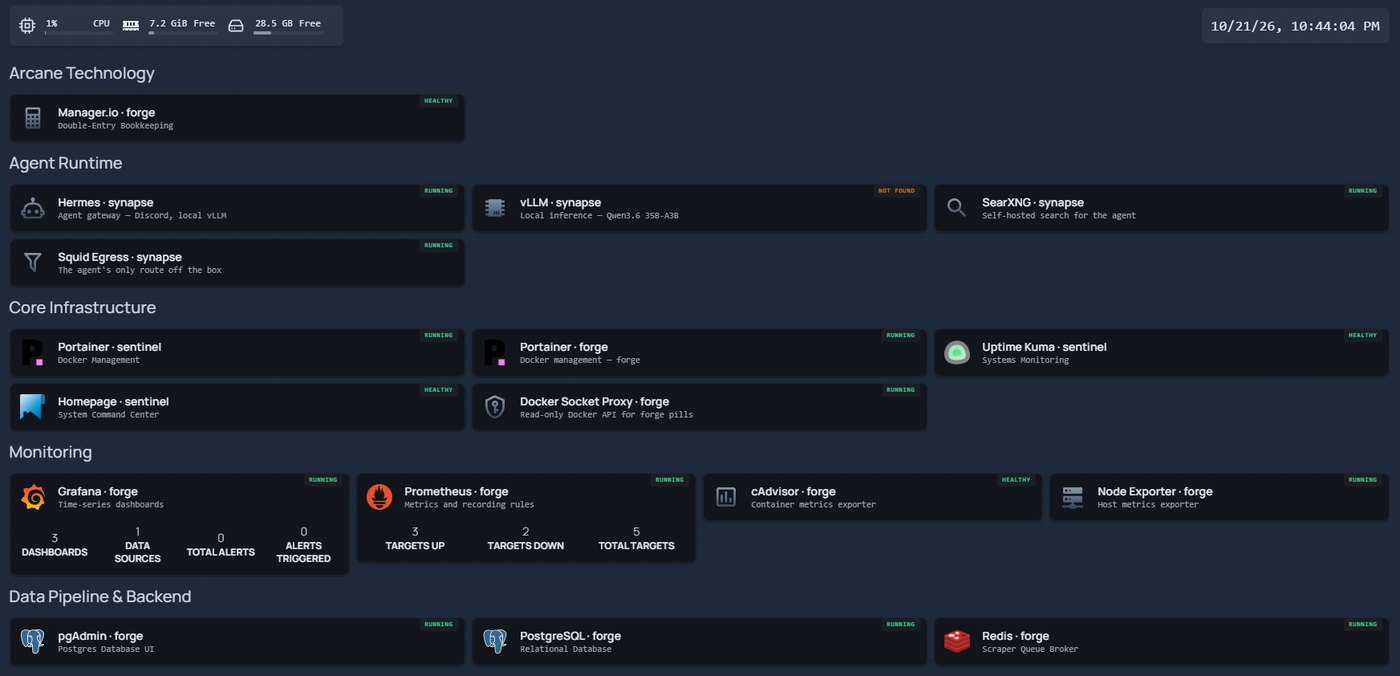
Homepage · sentinel
One screen for all three nodes, reading each one's containers through a read-only
socket proxy. Shown as it was, warts included: the vLLM tile's pill can't find its
container by name, and Prometheus has two targets down.
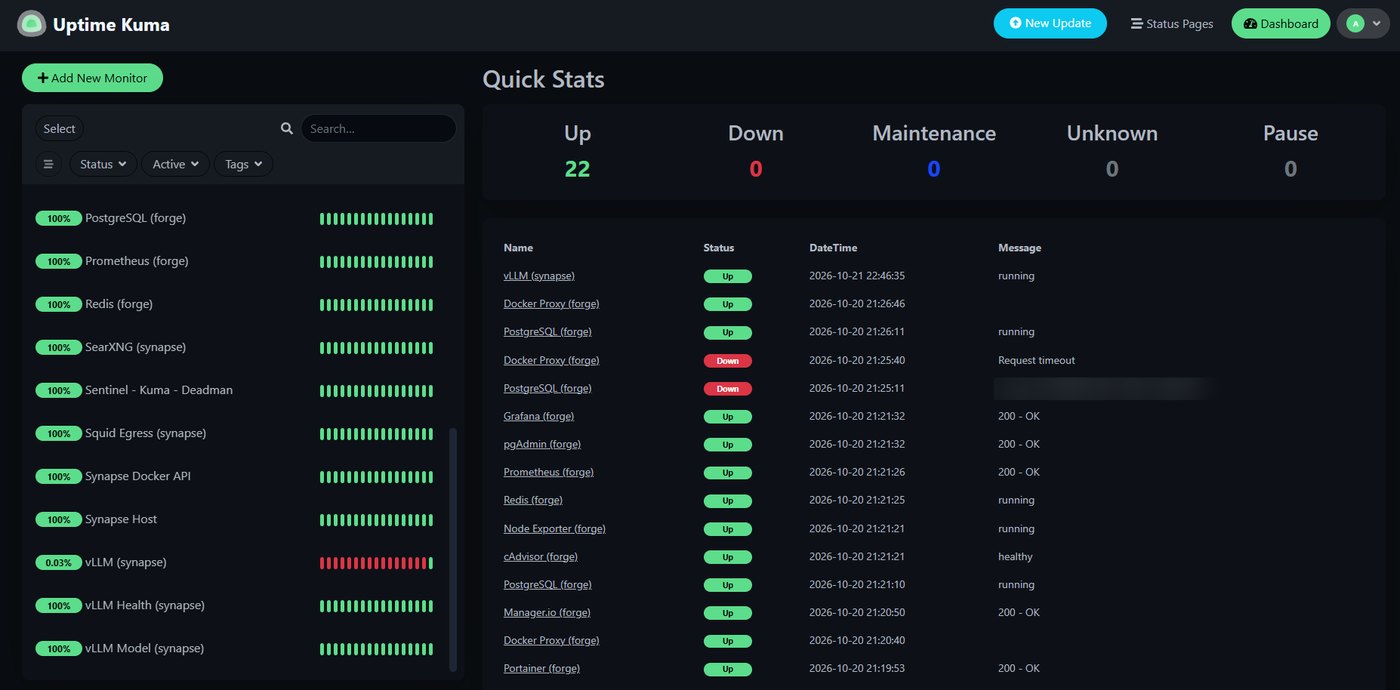
Uptime Kuma · sentinel
22 monitors, all up, watching forge and synapse from the Pi. The event log shows forge's
services dropping and coming back on the evening of 20 October. One error message is
blurred because it contained a tailnet address.
Project — Blink smart alerts
Blink's cameras record to a USB drive on the Sync Module for free, but anything
smarter than "motion happened" sits behind a subscription. This pipeline pulls each
clip off the module, archives it on forge, alerts on Discord, and then has the
local model on synapse describe what is in it — a one-line push notification like
"Delivery driver leaves a package at the front door."
How a clip moves
Ingest on forge. A watcher polls the Sync Module's local-storage
manifest through blinkpy, downloads each new clip, and files it as
camera / date / time with a JSON sidecar recording every timing.
Alert immediately. The raw clip is posted to Discord the moment it
lands. The alert never waits on AI — that is the one hard constraint.
Describe in the background. A detector service re-encodes the clip small
(2 fps, 640px, no audio — this bounds tokens per clip and drops a broken first
packet Blink writes) and sends the whole clip, as video, to vLLM on synapse.
Follow up. The one-sentence description posts as a reply under the
alert and is written into the sidecar. If synapse is down, the clip still saves
and still alerts — it just gets no description. No fallback, by choice.
How it got there — three designs in two days
Object detection first. YOLO26n through ONNX Runtime on two of forge's CPU
threads, posting a copy of the clip with boxes drawn. It proved the plumbing and
kept up easily, but a boxed video on a phone answers nothing a sentence does not
answer faster.
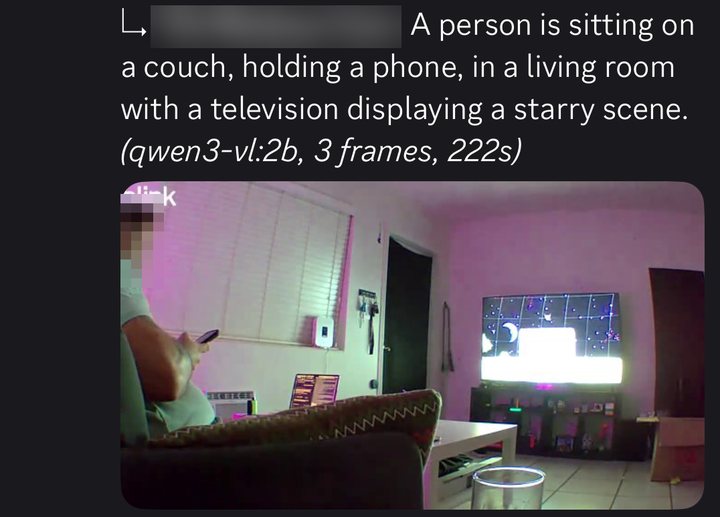
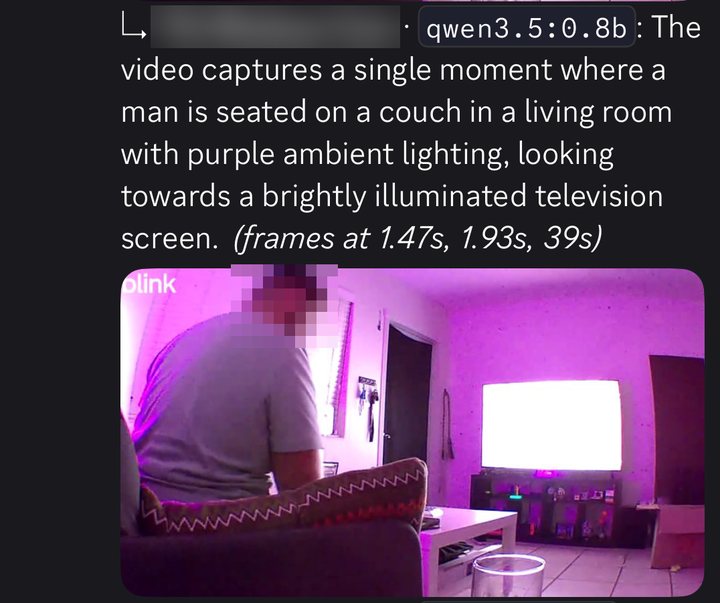
Then small vision models on forge's CPU. 0.8B–2B VLMs, single frames, then
three frames chained with notes carried between them. Accurate enough, but
39–224 seconds per clip on a 35W quad-core — a description that arrives four
minutes after the alert is history, not a notification.
Then the cheapest option, checked last when it should have been first: the
35B model synapse already serves for the agent accepts video natively; vision had
simply been switched off at launch. Turning it on cost nothing measurable — agent
throughput 238 vs 240 tok/s, the same reasoning and retrieval scores, roughly the
same VRAM — and the first real clip was described in 2.6 seconds. No
second model, no extra GPU memory, and the CPU experiments were deleted.
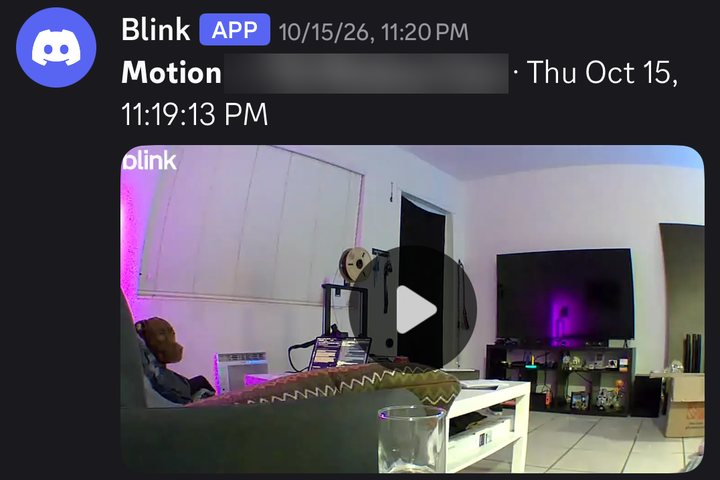
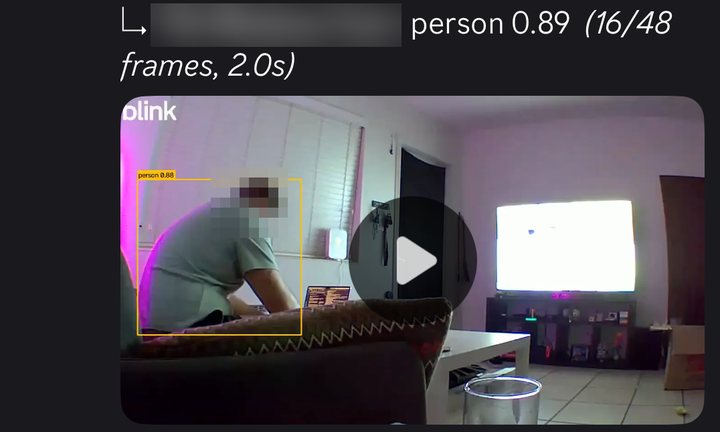
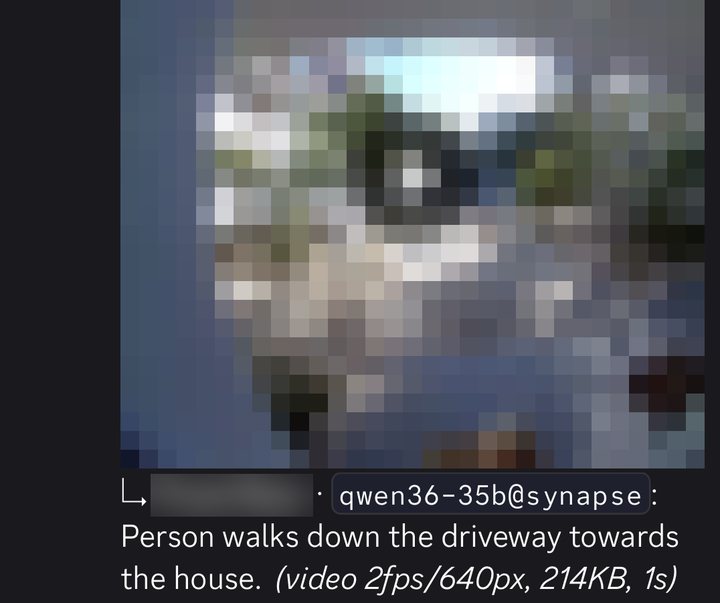
The same Discord channel across all four stages, unedited apart from cropping. Each
reply's own footer is the receipt: model, frames, and how long it took.
1 · Raw clipAlert with the clip attached. No AI yet.2 · YOLO26n on CPU2.0s. Fast and correct, but a box tells you little.3 · 2B VLM on CPUA real sentence, in 222s.4 · 0.8B, chained framesTwo models side by side. Best case 39s.5 · 35B on synapse, whole clip as videoOne push-notification sentence in 1s.
222 seconds down to one.
Faces, camera names and the exterior view are obscured. The captions are what matter.
Bugs worth keeping
Blink lies about frame rate. The reported rate is far above the real
(low, variable) one, so frame-index arithmetic put second 3 of a 10-second clip
past the end of the file. Frames are now picked by real presentation timestamp.
New cameras were silently dropped. The library learns camera names once at
startup and discards clips from any camera it does not know. Unknown cameras are
now accepted and trigger a re-read of the camera list from the cloud.
Renaming a camera re-posted its entire history. Seen-clip keys included the
camera name. They now key on recording time alone, and anything older than an hour
is marked seen rather than posted — alerts are for what is happening now.
Polling made the app say "system busy". Every manifest poll is a command the
Sync Module must process, and it collides with arm/disarm. A 48-hour probe logged
every read-only cloud endpoint on change and scored each field's precision and
recall against real clips, to find a cloud-side motion signal that can gate the
poll. Choosing the trigger from that data is the open step.
A login storm. A fatal error under restart: unless-stopped
re-logged into Blink every second. Fatal paths now back off ten minutes before
exiting.
Tradeoffs, stated plainly
Latency is minutes, not seconds — a clip appears only after recording finishes and
the module uploads it. Clips transit Blink's cloud on the way down, so this is not
fully local. The API is unofficial and one manifest read uses a private library
attribute, so the library is pinned to a known commit. The YOLO stack is AGPL —
fine privately, not something to hand a client. And the archive is a single copy
on one NVMe with no retention policy yet, which is the backups gap below.
v2 — a Pi Zero 2 W where the USB drive was
Designed, not built. One unverified assumption decides whether it works at all.
Most of v1's problems come from one fact: the clips sit on a drive only the Sync
Module can read, so every clip has to be asked for through Blink's cloud. v2 removes
that. A Raspberry Pi Zero 2 W plugs into the Sync Module's USB port and presents
itself as a USB drive (Linux USB gadget mode), backed by a disk image on the Pi's own
storage. The Sync Module records to it as it does to any drive, and the Blink app
keeps working. But the Pi can see each file the moment it is written, and send it to
forge over Tailscale. The Pi keeps nothing: it forwards clips and keeps only a short
buffer.
v1 problem
What v2 changes
Latency is minutes
No upload round-trip. Seconds after the clip is closed, bounded by how often the Pi re-reads the drive.
Clips transit Blink's cloud
Clips go from the camera to the Sync Module, then the Pi, then forge. Fully local.
Polling makes the app say "system busy"
No commands are sent to the Sync Module at all. The 48-hour probe for a cloud motion trigger becomes unnecessary.
Unofficial API, private attribute, pinned library
No Blink account in the ingest path. No login, no tokens, no 2FA, no login storms.
New or renamed cameras
Depends on how the module names files on the drive. Unknown until it is looked at.
Single-copy archive
Unchanged. That is the backups work, not this.
Checked before anything is bought, in this order:
Are the clips readable on the drive? Blink's documentation suggests clips
stored on the drive cannot be played on a computer, which would mean they are
encrypted. If so, v2 does not work as designed and v1 stays. This is a 10-minute
test: copy a few clips off the current drive and try to open them.
Reading a drive someone else is writing. In gadget mode the Sync Module
owns the filesystem, and the Pi reading the same image underneath it can see half-written
or stale data. The usual approach is a read-only mount refreshed on a short interval,
only taking files that have stopped growing. Unplugging and replugging the drive
virtually to copy is the fallback, but the module may react badly to its drive
vanishing.
Power. The Pi running Wi-Fi may draw more than the Sync Module's USB port
supplies. A separate power supply is likely.
SD wear. Continuous video writes to a microSD card are the same problem
sentinel already has. Use a high-endurance card, and treat the Pi as disposable.
Cost is roughly a Pi Zero 2 W and a card. Under the spend rule it fixes faults that
exist now (cloud transit, "system busy"), so it would pass, but only after the first
check comes back clean.
Stage
State
Clip ingest, archive, Discord alert
Running
Descriptions from synapse's vLLM
Running
Cloud-side motion trigger to replace polling
Analysing probe
v2: Pi Zero 2 W as the drive, fully local
Verify clip format first
Filter alerts (e.g. people only)
After a trust period
Archive to a NAS
When the NAS exists
Home Assistant reading the same archive
Later
Local AI — synapse
A fully local agent on a fully local model, reachable over Discord, with web search
and no paid APIs in the steady state.
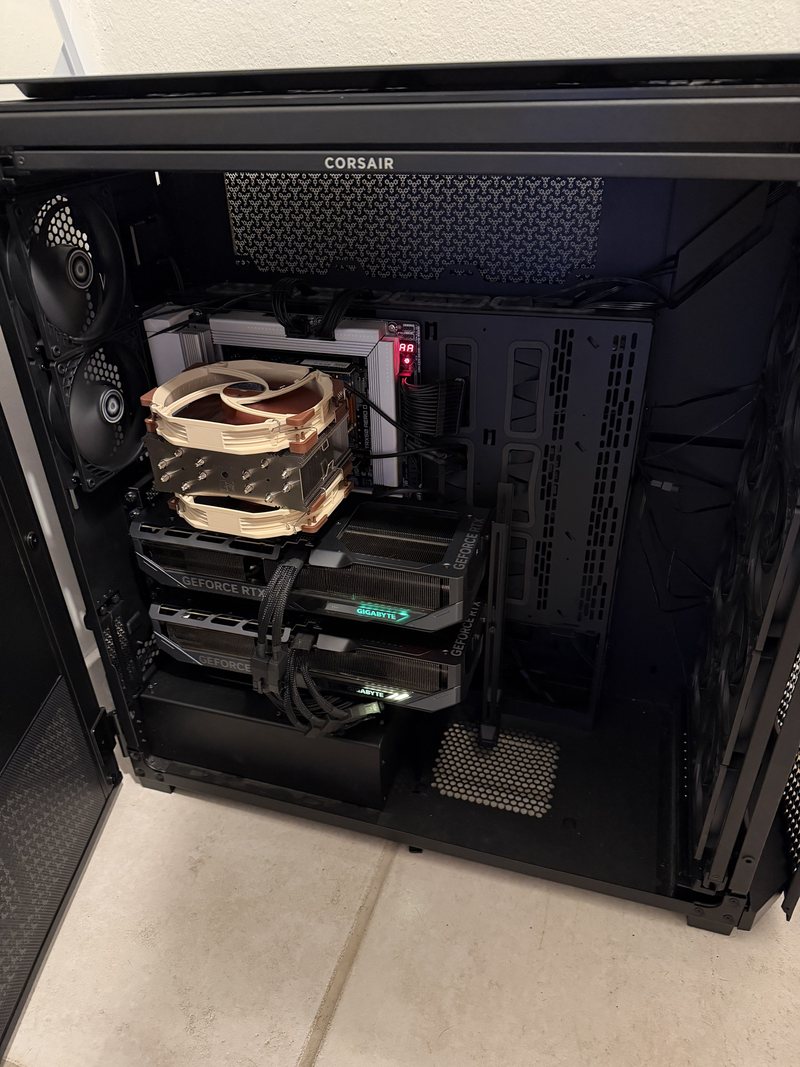
synapse, side panel off
Threadripper 9960X under a Noctua air cooler, two RTX 5070 Tis stacked below it.
Inference: vLLM serving Qwen3.6-35B-A3B at NVFP4, tensor-parallel across
both 16GB cards, 262K context, vision enabled. Chosen over a dense 27B after a
benchmark tied them on reasoning and tool use at 238 vs ~102 tok/s and 262K vs
~88K context.
Tuned from failures, not defaults. The speculative-decoding draft head
requested unprofiled memory and OOM-crashed vLLM twice, so it is off. Automatic
KV-cache sizing left ~76MB free per card, so the cache is a fixed size with real
headroom. Prefix caching caused long-prompt hangs on this hybrid architecture, so
it is off.
Agent: Hermes Agent in a container — non-root, no Docker socket,
no-new-privileges, 4GB and 512-PID limits. Only allowlisted Discord users
can command it, and memory or skill writes need explicit approval before they
persist.
synapse
$ nvidia-smi
Thu Oct 22 02:41:34 2026
+-----------------------------------------------------------------------------------------+
| NVIDIA-SMI 595.91.07              Driver Version: 595.91.07      CUDA Version: 13.2     |
+-----------------------------------------+------------------------+----------------------+
| GPU  Name                 Persistence-M | Bus-Id          Disp.A | Volatile Uncorr. ECC |
| Fan  Temp   Perf          Pwr:Usage/Cap |           Memory-Usage | GPU-Util  Compute M. |
|                                         |                        |               MIG M. |
|=========================================+========================+======================|
|   0  NVIDIA GeForce RTX 5070 Ti     Off |   00000000:81:00.0 Off |                  N/A |
|  0%   31C    P8              9W /  300W |   15612MiB /  16303MiB |      0%      Default |
|                                         |                        |                  N/A |
+-----------------------------------------+------------------------+----------------------+
|   1  NVIDIA GeForce RTX 5070 Ti     Off |   00000000:C1:00.0 Off |                  N/A |
|  0%   30C    P8              8W /  300W |   15612MiB /  16303MiB |      0%      Default |
|                                         |                        |                  N/A |
+-----------------------------------------+------------------------+----------------------+

+-----------------------------------------------------------------------------------------+
| Processes:                                                                              |
|  GPU   GI   CI              PID   Type   Process name                        GPU Memory |
|        ID   ID                                                               Usage      |
|=========================================================================================|
|    0   N/A  N/A          192195      C   VLLM::Worker_TP0                      15602MiB |
|    1   N/A  N/A          192196      C   VLLM::Worker_TP1                      15602MiB |
+-----------------------------------------------------------------------------------------+
Both cards, captured between requests: vLLM's two tensor-parallel workers hold
15.6 of 16.3GB each, which is the 95% memory budget it is configured
for, reserved up front rather than grown on demand. Idle, each card draws 8–9W.
Containment is the network, not the tooling
Prompt injection steering a tool call cannot be filtered out of web content
reliably, so the design limits what an injected agent can do rather than what it
can read. The agent sits on a Docker network created --internal: no gateway,
no NAT, no route off the box. Squid and SearXNG are the only containers on both that
network and an uplink, so they are the only exits, and Squid allows HTTPS to Discord
and five exact GitHub hosts — nothing else. Package indexes are deliberately blocked.
Dropping a proxy setting costs the agent its egress instead of granting it free
egress.
The read-only Docker API the dashboard uses is deliberately off the agent's network;
reaching it directly, through the proxy, and by container name was each verified to
fail.
Residual risks, written down rather than implied away: the Discord token is
readable inside the agent's container (a credential-injecting proxy would fix it and
is not built); the shell tool can write anywhere in the container, so the container
is the sandbox; fetched URLs and search queries are small exfiltration channels; and
the model API is open to every tailnet device without a key, the price of letting
the watchdog health-check it.
Next phase, not running yet: Hermes builds, Claude reviews.
Hermes takes a scoped task in Discord, works on a branch and opens a pull request —
never pushing to main. Claude Code reviews it; the review goes back to Hermes
or the PR is merged by hand. Waiting on a fine-grained token limited to selected
repositories, contents and pull requests only, with a short expiry.
Operational practice
Conventions applied across every compose file in the private config repo:
Every container has a mem_limit. A 16GB host with unbounded containers
is an OOM waiting to happen. The camera detector is additionally capped at two CPU
threads so a burst of clips cannot starve the databases.
Versions are pinned where a rebuild depends on them — the inference server,
the metrics stack, the egress proxy, the camera library. Several web front-ends and
the agent image still track latest; that is a known gap, not a policy.
Config is bind-mounted, state lives in named volumes. Config is in git;
state deliberately is not. The repo plus a Tailscale login is the rebuild path.
Reachability is a firewall property, not a bind-address property. Docker
continues to listen on all interfaces so containers can reach one another and
the host; the packet filter is what decides who gets through.
Services address each other by Tailscale MagicDNS name, not IP. Moving a
service between nodes becomes a volume copy rather than a config rewrite. Names
are set explicitly at join time — Tailscale otherwise derives them from the OS
hostname, and they silently stop matching the configs. That has cost an hour once.
Secrets never reach the repository..env is gitignored, .env.example
documents every variable with placeholder values, and gitleaks runs against
staged changes before every push.
Agents propose, a human executes. AI-assisted changes land as reviewable
commits and scripts; destructive commands and deployments stay human-gated.
Network security model
The design goal is that nothing is reachable without authenticating first, and
that being on the same physical network grants nothing at all.
Tailscale is the only transport between nodes. A WireGuard-based mesh
carries all inter-node traffic. There is no port forwarding on the router, no
reverse proxy exposed to the internet, and no public ingress of any kind. The
camera pipeline is outbound-only and publishes nothing.
Access is authenticated per device, not per network. A machine reaches
services because it has authenticated onto the tailnet — not because it
happens to sit on the right LAN. Revoking a device removes its access
everywhere at once.
The firewall is the enforcement boundary. External traffic is filtered in the
DOCKER-USER chain — evaluated ahead of Docker's own accept rules — so only
packets arriving over the Tailscale interface reach a published port. Host
SSH is restricted to the same interface via UFW.
The dashboard never gets a raw Docker socket. It reads container state
from each node through a read-only socket proxy, because a docker.sock over
the network is root on the node holding all the state.
The agent is contained by topology. An internal-only network with a single
allowlisting proxy as its exit — see Local AI above.
Closing a real gap: Docker's firewall bypass
The tailnet-only property was originally enforced by convention — every
published port was expected to carry an explicit bind address. Auditing it
showed that convention was not holding, and published container ports were
reachable from the LAN.
The cause is a well-known and easily-missed Docker behaviour: publishing a port
inserts iptables rules that are evaluated before the chain UFW manages. A
deny incoming default policy therefore does not block a published container
port. UFW reports the host as locked down while Docker has already accepted the
traffic.
That is the worst class of security bug in a homelab — not an open port, but a
system that reports itself as closed while it is open, so everything built on
top of it inherits a false assumption. The fix was to stop treating bind
addresses as a security control and put enforcement in the packet filter
instead: rules in the DOCKER-USER chain admit only traffic arriving over the
Tailscale interface, and host SSH is locked to that same interface with UFW.
The tradeoff is deliberate and worth stating: enforcement is now a single
control rather than layered. Because the listening sockets remain open on all
interfaces, the firewall rules are load-bearing, which makes their persistence
across reboots and Docker restarts a first-class operational concern rather
than a detail.
Recorded as ADR-0002, with a runbook covering verification — which has to be
done from a LAN host that is not on the tailnet, since checking from the host
itself passes trivially and proves nothing.
Planned hardening: single sign-on in front of the web interfaces, and tailnet ACLs
restricting which device may reach which service — which would also close the
keyless model API.
Architecture decisions
Decisions are recorded as ADRs at the time they are made, and amended or superseded
in place when they stop being true — rather than quietly rewritten. The configs show
what runs; the ADRs record why, including the ones that turned out wrong.
ADR-0001 — alerting must not share a failure domain with what it watches.
Uptime Kuma started on forge, which made forge a single point of failure for knowing
whether forge was up. It moved to the Pi. Prometheus and Grafana briefly followed it
there and then moved back: they answer "what was memory doing before the crash",
which is read afterwards from a box that is back up. The argument was always about
notification, not diagnosis, and the ADR stands as written.
ADR-0002 — reachability is enforced in the firewall. See the featured panel above.
ADR-0003 — contain an agent at the network layer, not just in config. Written for
an earlier runtime on forge and now superseded, but its reasoning — internal-only
network, proxy as sole exit, fail closed — is exactly what synapse runs today.
ADR-0004 — use the agent's built-in memory, not a vector database. The plan picked
a vector store on the premise that built-in memory was keyword-only. Installing it
showed the premise was wrong on every point: the built-in engine already did hybrid
keyword-and-vector search over plain markdown files, and the vector store held zero
rows for its entire life while the built-in system quietly did the work. The ADR
exists so the reversal is recorded rather than rediscovered.
zero rows. the whole time.
ADR-0005 — split runtimes by trust zone, then collapse back to one. A research
runtime and an execution runtime, separated by a human-moved file. Once the local
agent proved it could do both jobs, the second runtime was removed as redundant and
the ADR amended — including the parts of its security section that were never
actually built.
Building synapse was not justified by the spend rule, and that is written down.
Hardware here must fix a fault that exists now, remove a ceiling actually being hit,
or pay back within about six months. The GPU node was built on other grounds. That is
a legitimate decision — but the rule is not allowed to be quietly treated as though it
passed.
yes, I know.
The camera pipeline puts ingest on forge and AI on synapse. Clips are state, and
state lives on forge's NVMe, not the Pi's microSD. Descriptions are enrichment, so they
live on the node allowed to disappear.
Migrations and incidents
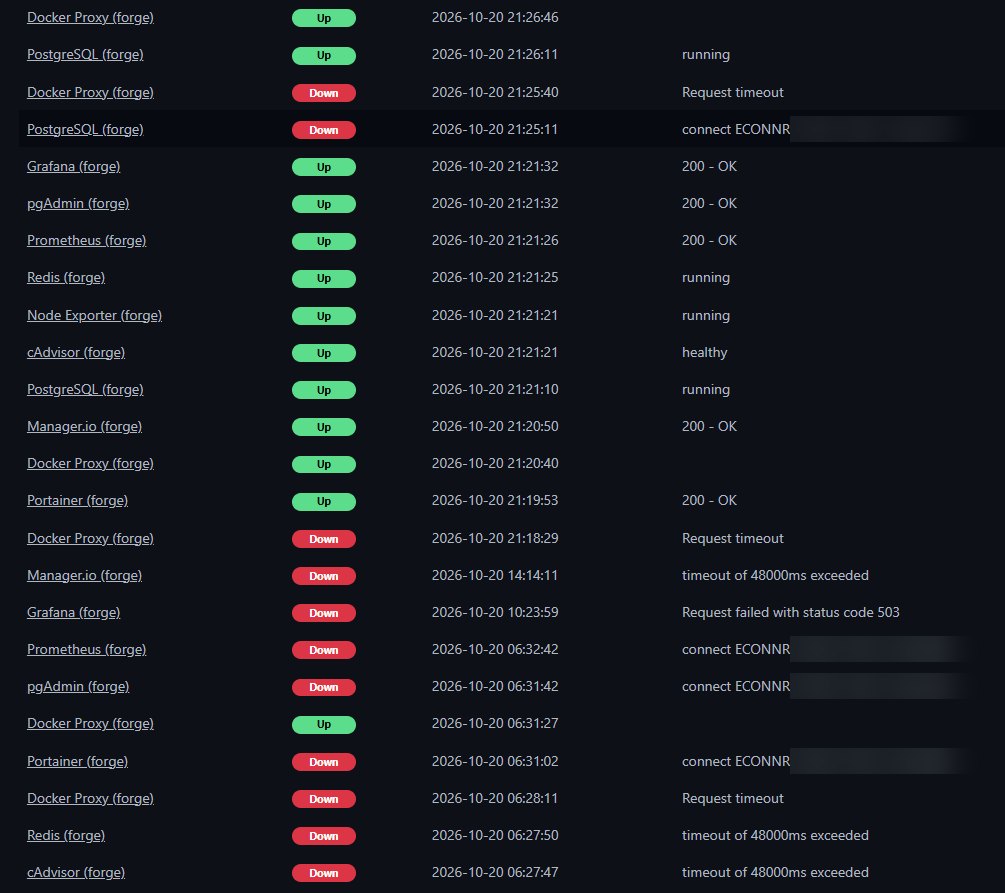
The drive fell asleep and took the filesystem with it. At 06:27
the forge monitors started going red: cAdvisor, Redis, the Docker proxy, Portainer, pgAdmin
and Prometheus inside five minutes. The NVMe drive's power saving had let it drop into its
deepest sleep state, and it came back read-only, so any process that touched the disk, to
read or to write, failed. It was not all at once: services kept running until they next
needed the disk, so Grafana held out until 10:23 and Manager.io until 14:14. One monitor
stayed green all day, watching a process that ran entirely from memory with no disk I/O.
A power cycle at 21:18 brought the drive back, every monitor was green by 21:21, and a
custom rule now keeps the drive out of that sleep state. About fifteen hours, start to
finish. Two lessons: a green check proves only the path it exercised, and the one drive
holding all of forge's state is one more argument for the backups that do not exist yet.
The Uptime Kuma event log from that day, newest first. Tailnet addresses blurred.the survivor never touched the disk
A power surge broke every published port — the services were fine. After an
unclean shutdown, every container on forge restored with correct port config but no
live port mappings: every monitor red, every service healthy. Docker's network state
is not crash-safe, and neither restarting containers nor the daemon rebuilds it —
only recreating the container does. Confirmed by elimination on the box, then fixed
with a boot-time healer that recreates only containers whose bindings are configured
but not live. A no-op on a clean boot. It found one more problem on the way: a
container started by hand, with no compose metadata, could not be recreated at all —
so it became a compose stack too.every light red, every service fine
Built the GPU node and moved inference onto it. A dual-GPU Threadripper
now serves the agent's model locally, on a node that is always on by design, with
hosted APIs no longer part of the steady state.
Agent runtime, three reversals. One runtime chosen, reversed for another,
split into two by trust zone, and finally collapsed to one local agent on synapse.
The removed runtime's config was deleted from the repo rather than left as files for
a stack that will not exist.
Uptime Kuma and Homepage → Pi. Done, per ADR-0001. Because every monitor
targets a MagicDNS name rather than an IP, the move was a volume copy rather than a
rewrite.
Docker firewall lockdown. Audited the tailnet-only invariant, found
published container ports reachable from the LAN, and moved enforcement into
DOCKER-USER. See ADR-0002.
Removed a container that did nothing. A browser worker ran
tail -f /dev/null against a directory that never existed in git — Docker
created it empty on every deploy. Deleted rather than propped up.
OptiPlex board replacement and 8→16GB RAM upgrade. Fixed a real fault and
lifted a ceiling that was actually being hit, which is what justified it.
Monitoring rollout. Prometheus recording rules pre-compute the values the
dashboard displays, because the widget passes PromQL in a URL query string and long
expressions become an encoding problem.
Build status
Built in public. This is a live project, so the page separates what runs today
from what is next — nothing below is listed as running unless it is.
Running now
Three-node split with workloads placed by node reliability. Tailscale-only mesh
enforced in the firewall (ADR-0002). Independent alerting and dashboard on the
Pi. Stateful stack, metrics and bookkeeping on forge, every container under a
memory limit, with boot-time port self-repair. Local 35B inference and a
network-contained agent on synapse. Blink camera alerts with AI descriptions.
ADR practice and secret scanning on every push.
In progress
Choosing a cloud-side motion trigger for the camera pipeline from the 48-hour
probe data. Agent-opens-PR, Claude-reviews workflow, pending a scoped token.
Pinning the images that still track latest.
Next
Data backups — the largest unaddressed risk: databases, documents,
monitoring history and the camera archive are single-copy today. Designed as
peer-to-peer nightly snapshots across nodes, with quarterly restore tests. Then
DNS filtering, single sign-on and tailnet ACLs, a fully local Blink v2 on a Pi
Zero 2 W, people-only camera alerts, and a
NAS once peer storage runs out.
Write it down. Especially when it’s wrong.
Note on scope
This is the public view. The configuration itself, runbooks, network addressing,
port bindings and firewall rules live in a separate private repository.